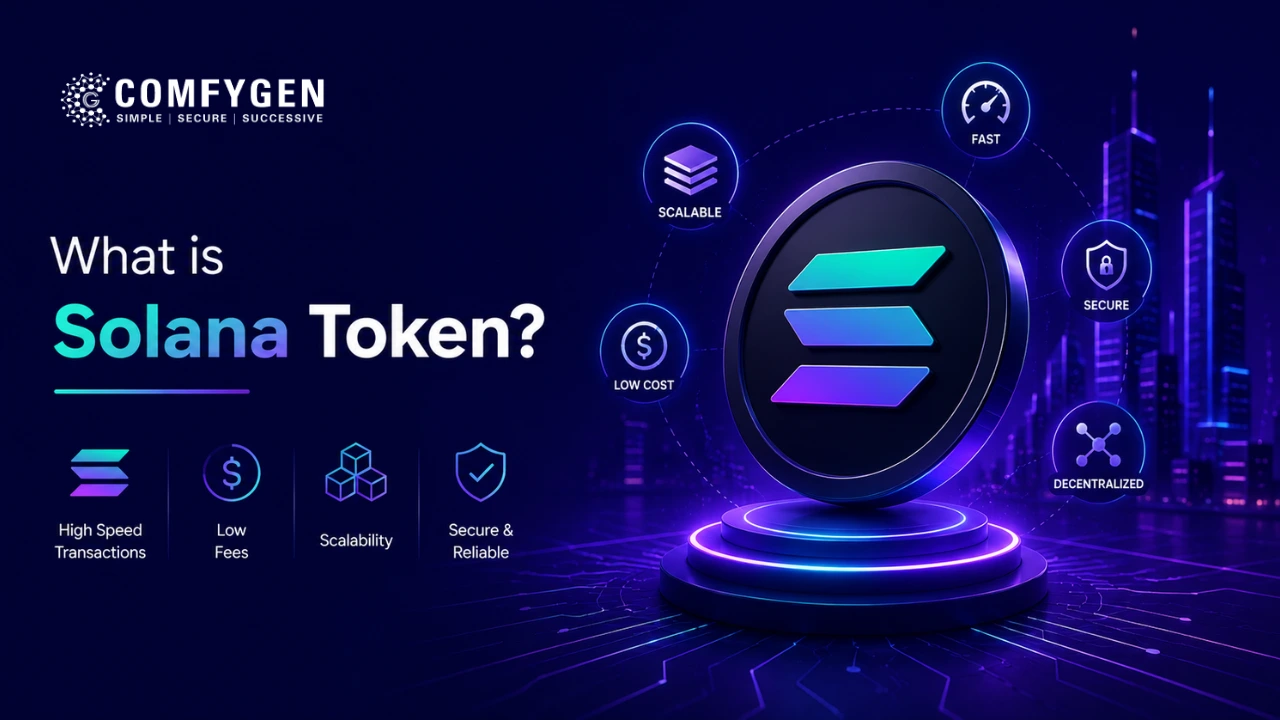





Solana processes 25.3 billion transactions in a single quarter. Average transaction fee: $0.00025. Block confirmation time: 400 milliseconds. Those numbers are not projections. They are Q1 2026 on-chain data.
If you are evaluating Solana for a token project, a DeFi application, or simply trying to understand what Solana tokens actually are and how they work, this guide covers it all: the underlying architecture, the SPL token standard, the newer Token-2022 extensions, real costs, and step-by-step creation basics.
What Is a Solana Token?
When most people say “Solana token,” they are referring to one of two things: SOL (the native coin of the Solana blockchain) or an SPL token (a custom digital asset created on top of Solana by developers or businesses).
SOL is built into the network itself. It is used to pay transaction fees, reward validators, and participate in staking. You cannot “create” SOL — it exists as a fundamental part of Solana’s protocol.
SPL tokens are different. SPL stands for Solana Program Library. Any developer, startup, or business can create an SPL token to represent almost anything: a stablecoin, a governance vote, a gaming asset, a loyalty point, or fractional ownership in a real estate property.
If you have sent USDC on Solana, held a Solana-based NFT, or used a DeFi protocol like Raydium or Jupiter, you have interacted with SPL tokens. Every token in the Solana ecosystem other than SOL itself follows this standard.
SOL vs. SPL Tokens: What’s the Difference?
SOL is the native asset. It is hardcoded into the network. SPL tokens are issued by external parties using Solana’s Token Program, a deployed smart contract that handles creation, transfer, and burning for every token on the network.
The distinction matters practically. When you pay a transaction fee on Solana, you pay in SOL. When you hold USDC, trade on a DEX, or participate in a token launch, you are dealing with SPL tokens. Both live on the same chain, but they serve different roles.
One of the architectural choices that makes Solana tokens different from Ethereum is that every SPL token uses a single shared Token Program. On Ethereum, each ERC-20 token is its own independent smart contract. On Solana, one program manages all fungible tokens. This reduces blockchain bloat and keeps costs predictable, but it requires developers to think about token ownership differently.
How Solana Works: PoH, PoS, and Why Speed Matters
Solana uses a combination of two consensus mechanisms: Proof of History (PoH) and Proof of Stake (PoS).
Proof of Stake selects validators to confirm transactions based on the amount of SOL they have staked. This is energy-efficient and widely used across modern blockchains. What makes Solana different is that it layers Proof of History on top of this.
Proof of History is a cryptographic clock. Instead of requiring validators to communicate with each other to agree on what time it is, Solana embeds timestamps directly into the blockchain. This eliminates a major coordination overhead. Validators do not need to wait for each other before processing the next block.
The result: Solana sustains 2,000–4,000 transactions per second under normal conditions, with an all-time mainnet peak of approximately 6,284 TPS. The theoretical ceiling under the current architecture is 65,000 TPS, and the Firedancer validator client introduced in late 2025 demonstrated over 1 million TPS in controlled testing.
For token projects, this throughput is not a marketing claim. It is the infrastructure that makes high-volume applications viable. In August 2025, a Solana developer confirmed 100,000 TPS on mainnet in live conditions. Ethereum’s base layer, by comparison, processes approximately 15–24 TPS.
The SPL Token Standard: How Tokens Are Built on Solana
The SPL Token Standard defines how fungible tokens operate on Solana. It is the Solana equivalent of Ethereum’s ERC-20, but with a different account structure.
Every SPL token relies on three key components:
Token Program
The Token Program is a single on-chain program deployed at a fixed address. It contains all the logic for creating, transferring, and burning tokens. Every SPL token on the entire network shares this same program there is no need to deploy a new contract per token.
Mint Account
The Mint Account is one account per token type. It stores the token’s total supply, decimal configuration, mint authority (who can create new tokens), and optional freeze authority (who can lock accounts). The mint address is the unique identifier of the token. USDC on Solana, for example, lives at a specific mint address that every wallet and exchange references.
Token Accounts
Token Accounts (also called Associated Token Accounts or ATAs) hold a specific user’s balance for a specific token. Your USDC balance does not live in your main wallet, it lives in a separate token account tied to your wallet address and the USDC mint. Most wallets create these automatically when you receive a new token.
This structure means tokens are separated cleanly from each other. If you hold five different SPL tokens, you have five separate token accounts. Your wallet manages these in the background so you do not see the complexity.
For developers building on Solana with custom crypto token development, understanding this account model is important for calculating storage costs and designing token flows correctly.
Token-2022 and Token Extensions
The original SPL Token Program was intentionally simple. It managed one thing: token balances. Developers who needed additional functionality transfer fees, vesting schedules, KYC requirements had to write custom wrapper programs. That added complexity, increased attack surfaces, and fragmented liquidity across DeFi.
Token-2022 (also called the Token Extensions Program) changes this. Released by Solana Labs, Token-2022 is a new program that maintains full compatibility with the original SPL token standard while adding modular extensions directly into the mint and token account data structures.
The key extensions include:
Transfer Fees
Tokens can automatically charge a configurable fee on every transfer. This is useful for DeFi protocols and platforms that need to capture a percentage of token movement without a separate fee collection contract.
Confidential Transfers
Transfers can be made privacy-preserving using zero-knowledge proofs. The transaction occurs on-chain, but the amounts are not publicly visible.
Non-Transferable Tokens
Tokens can be permanently bound to a wallet. This is used for credentials, certifications, and soul-bound identity tokens.
Permanent Delegates
A designated address retains the ability to transfer or burn tokens from any holder’s account. This is used in stablecoin compliance scenarios where issuers need to claw back funds from sanctioned addresses.
Default Account State
New token accounts can be frozen by default, requiring a whitelist process before a holder can transfer tokens. This is used in regulated asset issuance.
Required Memos
Every transfer must include a memo. This is used in institutional settings where transaction labeling is required for compliance.
PayPal’s PYUSD on Solana is the most prominent Token-2022 deployment in production. It uses confidential transfer support and a permanent delegate for compliance freezes. Circulating supply of PYUSD sits at approximately $3.4 billion across Ethereum and Solana combined as of mid-2026.
For projects building DeFi applications or tokenized real-world assets on Solana, Token-2022 is the correct standard to use in 2026 if your token requires any programmable compliance or business logic.
Types of Solana Tokens and Their Use Cases
The SPL standard supports several distinct token categories, and the right choice depends entirely on what you are building.
Fungible Tokens
Fungible Tokens are interchangeable units where one token equals another. Stablecoins like USDC and USDT are fungible. Governance tokens for DeFi protocols are fungible. If you are launching a utility token for your application, you are building a fungible SPL token.
Non-Fungible Tokens (NFTs)
Non-Fungible Tokens (NFTs) are SPL tokens with a supply of exactly 1 and zero decimal places. Each NFT is unique. The Solana NFT market processed over $1.2 billion in trading volume in Q1 2025 alone. NFT development on Solana typically uses the Metaplex metadata standard on top of SPL.
Liquid Staking Tokens
Liquid Staking Tokens represent staked SOL in a liquid form. When you stake SOL through Marinade Finance, you receive mSOL. With $1.9 billion staked, jitoSOL has become one of the most widely accepted liquid staking tokens across Solana’s lending markets and DeFi protocols.
Governance Tokens
Governance Tokens give holders voting rights over protocol parameters. They are used across Solana’s DeFi ecosystem for proposals around fee structures, treasury management, and feature rollouts.
Real-World Asset (RWA) Tokens
Real-World Asset (RWA) Tokens represent ownership in off-chain assets. Total RWA value on Solana reached over $2.5 billion by April 2026. Solana recorded $144 million in tokenized equities trading in Q1 2026 — a network record. For businesses looking at blockchain-based real-world asset tokenization, Solana’s throughput makes it one of the better-suited chains for high-frequency RWA settlement.
Meme and Community Tokens
Meme and Community Tokens make up a significant portion of Solana’s transaction volume. BONK, launched as an airdrop in late 2022, now has over 117 integrations across 10 chains and functions as a tipping token and reward currency across Solana’s gaming and NFT ecosystem.
Real Solana Tokens You Already Know
Understanding Solana tokens becomes clearer when you look at specific examples that are already operating at scale.
USDC on Solana
USDC on Solana is issued by Circle and lives at mint address EPjFWdd5AufqSSqeM2qN1xzybapC8G4wEGGkZwyTDt1v. It is the dominant stablecoin on Solana and the primary quote asset on major DEXs including Jupiter, Raydium, and Orca. Circle kept USDC on the original Token Program, not Token-2022.
USDT on Solana
USDT on Solana is issued by Tether. Tether reports SPL USDT as one of its faster-growing supply venues alongside Tron and Ethereum. Total USDT circulating supply across all chains sits at approximately $189.5 billion as of mid-2026.
PYUSD
PYUSD is PayPal’s stablecoin issued by Paxos on Solana via Token-2022. Its use of Token-2022’s confidential transfer and permanent delegate extensions makes it the most prominent production example of Token-2022 compliance features.
jitoSOL
jitoSOL is a liquid staking token from Jito Labs with $1.9 billion staked. The JTO governance token gives holders voting power over validator selection and reward distribution.
BONK
BONK is the first community meme coin on Solana, initially distributed as an airdrop to active users and NFT holders. It now operates as a reward currency in games and NFT platforms, with deep DEX liquidity and broad wallet support.
Solana vs. Ethereum: A Direct Comparison
The comparison matters for anyone deciding which chain to build on. Here are the actual numbers:
|
Metric |
Solana |
Ethereum |
|---|---|---|
|
Real-world TPS |
1,000–4,000 |
15–24 |
|
Theoretical max TPS |
65,000+ |
~100,000 (post-sharding) |
|
Average transaction fee |
$0.00025 |
$2.93 |
|
Block time |
~400ms |
~12 seconds |
|
Consensus |
PoS + PoH |
PoS |
|
Token standard |
SPL (Token Program) |
ERC-20 (per-contract) |
|
DeFi TVL (Q1 2026) |
$9.3 billion |
Significantly larger |
Ethereum’s DeFi ecosystem remains larger in raw TVL. Its developer tooling (Solidity, Hardhat, Foundry) is more mature, and its network effects in institutional DeFi are stronger. Ethereum’s path to scale runs through Layer 2 rollups, not the base chain.
Solana scales on Layer 1. That architectural choice means lower fees, faster confirmation, and simpler user experience for high-throughput applications. The tradeoff is that Solana’s Rust-based development environment has a steeper learning curve for developers coming from Ethereum.
For token projects that require low transaction costs, high volume, or consumer-facing speed, Solana is a practical choice. For projects where Ethereum composability or EVM compatibility is required, Ethereum or an EVM-compatible chain makes more sense.
If you are building on Solana, explore Comfygen’s Solana blockchain development and Ethereum blockchain development services to compare implementation paths.
How to Create a Solana Token in 2026
There are three practical methods for creating a Solana token, each suited to different technical levels and project requirements.
Method 1: No-Code Token Creators (Beginner)
Platforms like Smithii, Solana Token Creator, and similar tools let you create an SPL token through a browser interface. You connect a Solana wallet (Phantom or Solflare), fill in the token name, symbol, decimals, and initial supply, and approve the transaction.
The process takes under 10 minutes. You do not need to write code. The platform deploys the mint account and sets you as the mint authority automatically.
This method works for basic fungible tokens, meme coins, and community tokens where simplicity is the priority.
Method 2: Solana CLI (Technical)
The Solana CLI gives you direct control over token creation with only network fees — no platform fee.
The sequence of commands:
spl-token create-token– creates the mint account, returns the mint addressspl-token create-account <MINT_ADDRESS>– creates a token account to hold the supplyspl-token mint <MINT_ADDRESS> <AMOUNT>– mints the initial supply to your account
This method requires installing the Solana CLI, funding a wallet with SOL for rent and fees, and understanding how to handle keypairs securely. It is the right approach for developers who want full control and want to script deployment as part of a larger project.
Method 3: Anchor Framework (Production Development)
For any commercial token project, the Anchor framework is the industry standard for Solana smart contract development. Anchor abstracts a significant portion of Solana’s low-level account management into cleaner TypeScript/Rust interfaces.
In 2026, production-level Solana token projects also integrate with dedicated RPC providers like Helius or QuickNode to ensure transactions never fail during network congestion, and use ZK Compression for projects that need to issue tokens at massive scale (fractional ownership, for example) at minimal cost.
For a custom token with specific tokenomics, vesting schedules, or compliance requirements, working with a blockchain development company that knows Solana’s architecture saves significant time and prevents costly errors.
Key Decisions Before You Create a Token
Before writing a single line of code or clicking a no-code button, you need to determine:
Which token program to use
Standard SPL for simple fungible tokens; Token-2022 if you need transfer fees, compliance hooks, non-transferability, or confidential transfers.
Decimal places
USDC uses 6 decimals. Most community tokens use 9. This decision is permanent after mint creation — you cannot change it.
Authority management
You can revoke mint authority (no new tokens can ever be created) and freeze authority (accounts cannot be frozen). Revoking authorities builds trust with holders. Serious projects almost always revoke both.
Supply model
Fixed supply (mint authority revoked on launch) or inflationary (mint authority retained for future emissions). Each has different implications for token economics.
Cost to Create a Solana Token
Solana token creation is significantly cheaper than Ethereum, but costs vary depending on your method and feature requirements.
Solana CLI (Network Fees Only)
The cheapest option. You pay approximately 0.002–0.01 SOL in network fees for the mint account and associated transaction costs. At SOL’s price range in mid-2026, this amounts to a few dollars. No platform fee.
No-code Platforms
These charge a service fee on top of the network rent. A basic token creation typically costs around 0.1 SOL (the base fee covers mint account creation and metadata). At $75–$150 SOL price, that is roughly $7.50–$15 for a basic token.
Optional Additions
Each authority revocation (mint, freeze, update) costs approximately 0.1 SOL. Revoking all three adds 0.3 SOL to your total. Creator information and social link metadata costs another 0.1 SOL on most platforms.
Full Premium Token via No-Code Platform
Approximately 0.6 SOL total, covering base fee, three authority revocations, and creator info.
Custom Development
This is where real project investment starts. For a token with custom tokenomics, a vesting contract, staking mechanics, or Token-2022 extensions, development costs start at $2,000 and scale with complexity. A production-grade token launch with audits, liquidity provision, and DEX integration runs considerably higher.
Ethereum, for comparison, typically costs $50–$200 in gas fees just to deploy an ERC-20 contract before any platform or development fees. During network congestion, Ethereum deployment costs spike significantly higher.
Can You Make Passive Income with Solana?
Yes, but the risks are real and need to be understood clearly.
Staking SOL
Staking SOL is the most straightforward passive income mechanism. You delegate SOL tokens to a validator node. The validator earns block rewards for processing transactions, and you receive a share of those rewards proportional to your stake.
The current Solana staking yield varies by validator but typically runs in the 5–7% annual range. To stake, you need a Solana wallet and a validator selection wallets like Phantom and Solflare surface this directly in the interface.
Liquid Staking
Liquid staking through protocols like Marinade Finance or Jito is a step up. You stake SOL and receive mSOL or jitoSOL in return. These are liquid tokens you can deploy in other DeFi applications lending markets, liquidity pools while your underlying SOL continues earning staking rewards.
Providing Liquidity
Providing liquidity on DEXs like Raydium or Orca earns you trading fees from the swap volume that flows through your liquidity position. This carries impermanent loss risk, which is a real cost when token prices diverge.
One important point: Solana is volatile. From April 2025 peak to year-end, SOL saw a 34% pullback. Staking returns of 5–6% annually do not protect you from a price decline of that magnitude. Never stake or provide liquidity with funds you cannot afford to leave locked or at risk.
Is Solana a Good Investment in 2026?
This is a genuinely difficult question to answer definitively, and anyone who gives you a confident yes or no is guessing.
What the data shows: Solana is the leading Layer-1 blockchain by transaction volume, with 25.3 billion transactions processed in Q1 2026 alone. It has the highest daily active wallet counts of any non-Ethereum blockchain. Its DeFi TVL sits at $9.3 billion, making it the third-largest DeFi ecosystem after Ethereum and Binance Smart Chain. Firedancer’s deployment in late 2025 addressed the single-client dependency concern that critics raised for years. Uptime now exceeds 99.98%.
The institutional narrative has also developed concretely. Spot SOL ETFs were approved in October 2025. B2C2, backed by SBI Holdings, designated Solana as its primary network for institutional stablecoin settlement. Meta added USDC on Solana support for creator payouts in multiple countries.
These are real adoption signals, not speculation.
The risks are also real. Solana’s history includes network outages that were embarrassing for the ecosystem. The meme coin activity that drives a significant portion of its transaction volume is speculative and cyclical. Competition from Ethereum Layer-2 solutions (which continue to improve), Sui, Aptos, and other high-throughput chains is growing.
If you are considering investment in Solana specifically for a development project — launching a token, building a DeFi product, or tokenizing an asset — the infrastructure case is strong. If you are considering SOL as a speculative asset, apply standard risk management: position sizing, stop losses, and never allocating more than you can afford to lose entirely.
Final Thoughts
Solana’s token infrastructure is genuinely capable. The SPL standard provides a clean, shared framework for fungible token creation. Token-2022 extensions add compliance and programmability features that make it viable for institutional and regulated use cases. The network’s throughput and fee structure make it practical for high-volume consumer applications.
Whether you are looking to launch your own token, build a DeFi protocol, explore real-world asset tokenization, or simply understand what you are interacting with in a Solana wallet, the fundamentals covered here give you a solid working picture.
For businesses and startups looking to build on Solana, Comfygen’s team has delivered production blockchain projects across DApp development, smart contract, and NFT marketplace development. If you have a Solana token project in mind, get in touch and we can work through the technical and commercial requirements with you.
Frequently Asked Questions
What is a Solana token?
A Solana token is a digital asset built on the Solana blockchain using the SPL (Solana Program Library) token standard. Solana tokens are separate from SOL — the native coin used to pay transaction fees. Developers and businesses create SPL tokens to represent stablecoins, governance rights, gaming assets, loyalty points, or ownership in real-world assets. Every token you interact with on Solana DeFi protocols, NFT markets, or wallets (other than SOL itself) is an SPL token.
What is the difference between SOL and SPL tokens?
SOL is the native currency of the Solana blockchain. It is hardcoded into the protocol and used for gas fees and staking. SPL tokens are custom assets created by third parties on top of Solana's infrastructure. USDC on Solana, BONK, and jitoSOL are all SPL tokens. SOL is to SPL tokens what ETH is to ERC-20 tokens on Ethereum — the base layer asset versus the application-layer assets built on top.
What does SPL stand for?
SPL stands for Solana Program Library. It is a collection of on-chain programs maintained by Solana Labs that defines standards for common blockchain functions. When developers refer to an "SPL token," they mean a token created using the SPL Token Program — a single shared smart contract deployed on Solana that handles all token creation, transfers, and burns across the entire network.
How much does it cost to create a Solana token?
The minimum cost is approximately 0.002–0.01 SOL using the Solana CLI directly, which only incurs network fees. Using a no-code platform, the base cost is around 0.1 SOL for mint creation and metadata. Each authority revocation (mint, freeze, update) adds 0.1 SOL each. A fully configured token with all three authorities revoked and creator info added costs approximately 0.6 SOL total. At mid-2026 SOL prices, that is roughly $45–$90. Custom development for tokens with vesting contracts, staking mechanics, or Token-2022 extensions starts at $2,000 and scales with complexity.
What is Token-2022 on Solana?
Token-2022 is an upgraded token program on Solana that extends the original SPL token standard with optional modular features called extensions. These include transfer fees (automatic percentage charged on every transfer), confidential transfers (privacy-preserving transactions using zero-knowledge proofs), non-transferable tokens (permanently bound to a wallet), permanent delegates (compliance-based authority to claw back tokens), and default frozen accounts (whitelist-based transfers). PayPal's PYUSD on Solana is the most prominent production deployment of Token-2022. For regulated assets and institutional use cases, Token-2022 is the recommended standard in 2026.
How do I create a Solana token without coding?
You can create a basic SPL token without writing code using no-code platforms like Smithii or SolanaTokenCreator. Connect a Solana wallet (Phantom or Solflare), enter the token name, symbol, decimals, and initial supply, and approve the transaction. The platform deploys the mint account and assigns you as the mint authority. The entire process takes under 10 minutes. For a serious project, you should also revoke mint and freeze authorities after creation to build holder trust — this costs an additional 0.2 SOL on most platforms.
What is a mint account on Solana?
A mint account is the on-chain account that defines a specific token on Solana. It stores the token's total supply, decimal configuration, the mint authority (who can issue new tokens), and the optional freeze authority (who can lock token accounts). Every token on Solana has exactly one mint account, and its address serves as the token's unique identifier. USDC on Solana is identified by a specific mint address that all wallets and exchanges reference. You cannot have multiple mint accounts for the same token.
Can I create an NFT on Solana using SPL tokens?
Yes. NFTs on Solana are SPL tokens with a total supply of exactly 1 and zero decimal places. The uniqueness is enforced at the mint level. Most Solana NFT projects also attach metadata using the Metaplex standard, which stores the NFT's name, image, and attributes on-chain or via IPFS.
How fast is Solana compared to Ethereum for token transactions?
Under normal conditions, Solana processes 2,000–4,000 transactions per second with block confirmation in approximately 400 milliseconds. Ethereum's base layer processes roughly 15–24 TPS with block times around 12 seconds. Average transaction fees on Solana are approximately $0.00025, compared to $2.93 on Ethereum. For high-volume token applications — payments, gaming, DeFi — the speed and cost difference is significant in practical terms.
What are real-world asset (RWA) tokens on Solana?
RWA tokens represent ownership of off-chain physical or financial assets — real estate, government bonds, equities, commodities — as on-chain digital tokens. Solana has become one of the primary networks for RWA tokenization due to its transaction throughput and low fees. Total RWA value on Solana reached over $2.5 billion by April 2026. Solana recorded $144 million in tokenized equities trading in Q1 2026 alone. Token-2022's compliance extensions (transfer restrictions, default frozen accounts, permanent delegates) make it well-suited for the regulatory requirements that RWA tokens typically carry.

Mr. Saddam Husen, (CTO)
Mr. Saddam Husen, CTO at Comfygen, is a renowned Blockchain expert and IT consultant with extensive experience in blockchain development, crypto wallets, DeFi, ICOs, and smart contracts. Passionate about digital transformation, he helps businesses harness blockchain technology’s potential, driving innovation and enhancing IT infrastructure for global success.