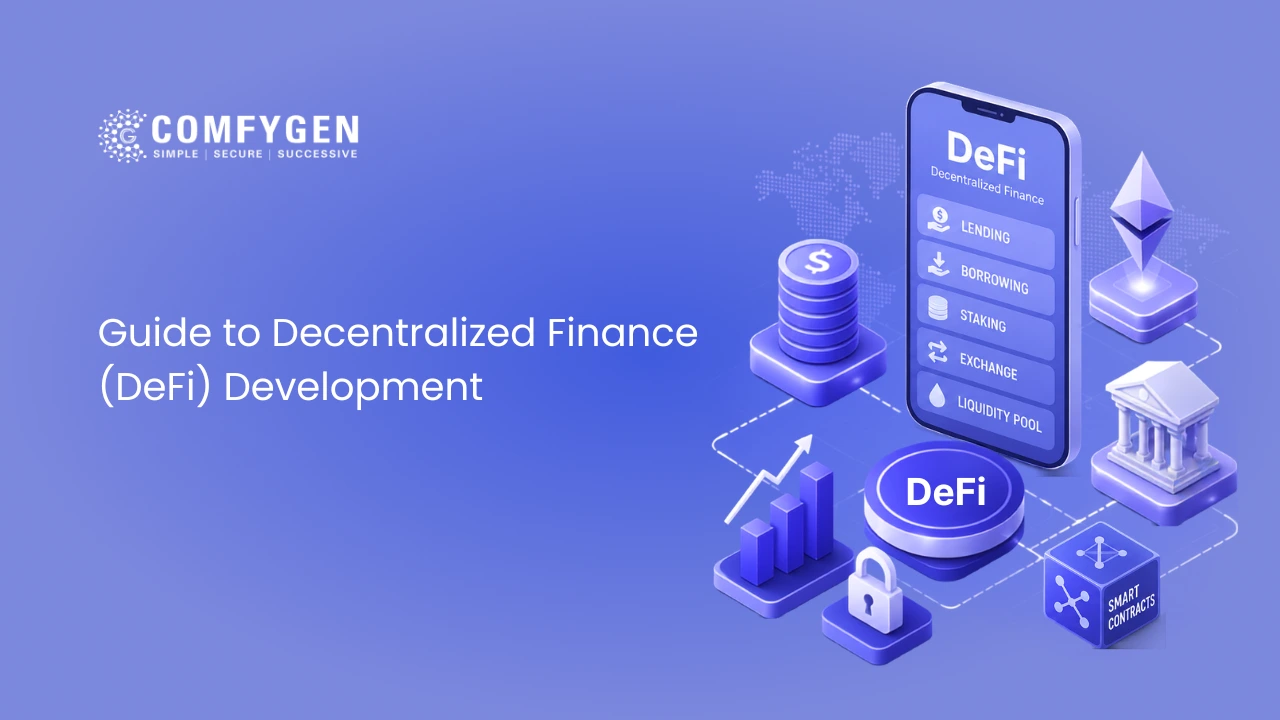





Money has always moved through gatekeepers. Banks decide who gets an account, payment networks decide which transactions are clear, and lenders decide who qualifies. Decentralized finance rewrites that arrangement by replacing the institution with code that anyone can inspect and use. That single shift is why DeFi has grown from a niche experiment into a financial layer that settles billions of dollars every day without a head office anywhere.
This guide is written for founders, product teams, and businesses weighing a move into the space. Rather than repeat the usual textbook definition, we focus on what actually goes into decentralized finance development in 2026: the state of the market, the platforms you can build, the technology behind them, realistic costs, the risks worth respecting, and where India’s rules fit in.
What Decentralized Finance Really Means
Decentralized finance, or DeFi, is a set of financial services — lending, borrowing, trading, saving, insurance — built on public blockchains and run by smart contracts instead of companies. A smart contract is a small program deployed on a network like Ethereum that executes exactly as written the moment its conditions are met. Once it is live, no employee approves your transaction and no branch closes for the weekend.
Three properties define the model. It is permissionless, meaning anyone with a wallet and an internet connection can participate. It is non-custodial, meaning users hold their own assets rather than handing them to an intermediary. And it is transparent, because the contract code and every transaction sit on a public ledger that anyone can audit. Those qualities are what make smart contract development the true engine of any DeFi product — the contract is the bank, the exchange, or the lender.
For the roughly two billion people the traditional system leaves out, this matters. A person without formal identity documents or a nearby bank can still supply liquidity, earn yield, or take a collateralized loan, provided they can reach the network. That reach, more than any speculative headline, is the durable case for building in this space.
The DeFi Market in 2026: Where the Numbers Stand
Honest reporting means acknowledging that 2026 has been a volatile year. Total value locked (TVL) — the amount of capital deposited across DeFi protocols — fell around 37% during the year to roughly $71.8 billion by mid-June 2026, down from about $114.5 billion at the start of January. Ethereum still anchors the ecosystem, holding just over half of all locked value, while stablecoins in circulation have climbed past $314 billion, several times the size of TVL itself.
The drawdown does not mean the sector is shrinking structurally. Longer-range forecasts still project the global DeFi market growing from about $26.9 billion in 2025 toward $1.4 trillion by 2033 at a compound rate near 68%, and unique users reached roughly 27.7 million in 2025. What has changed is where the capital sits: real-world asset tokenization crossed $26 billion in TVL, signalling that institutional money is entering DeFi through tokenized treasuries and yield-bearing stablecoins rather than speculative farming.
The takeaway for anyone planning a build is that price cycles and locked value swing hard, but the infrastructure keeps maturing. Products grounded in real utility — payments, lending, tokenized assets — are the ones weathering the volatility.
DeFi vs. Traditional and Centralized Finance
It helps to place DeFi against the two systems it competes with. Traditional finance runs through banks and clearing houses, with limited hours, multi-day settlement, and services confined to the country where the institution operates. Centralized crypto finance (CeFi) — a custodial exchange, say — feels modern but still holds your assets and can freeze accounts or be shut down by an outside party.
|
Feature |
Traditional / CeFi |
Decentralized Finance |
|---|---|---|
| Custody of funds | Held by the institution | Held by the user |
| Operating hours | Limited / business hours | 24/7, always on |
| Settlement time | Hours to days | Near real-time |
| Access | Localized, gated by KYC | Global, permissionless |
| Transparency | Closed, proprietary | Open-source, auditable |
| Cost structure | Intermediary fees | Mostly network fees |
The trade-off is real: DeFi hands users freedom and control, but it also hands them responsibility. There is no support desk to reverse a mistaken transfer. Good product design — clear interfaces, safety prompts, tested contracts — is how a serious build closes that gap.
Types of DeFi Platforms You Can Build
“DeFi development” is an umbrella term. Deciding which product you are building shapes every technical and budget decision that follows. The common categories include:
Decentralized Exchanges (DEXs)
Platforms that let users swap tokens directly from their wallets using automated market makers, the way Uniswap does. This is the largest and most competitive DeFi segment, and a solid entry point for teams with strong decentralized exchange development experience.
Lending and Borrowing Protocols
Systems where users supply assets to earn interest or borrow against collateral, modelled on Aave and Compound. These are contract-heavy and demand the most rigorous auditing because they hold pooled user funds.
Yield Farming and Staking Platforms
Products that reward users for locking assets into liquidity pools or staking contracts. Complexity rises quickly once governance tokens and multiple reward pools enter the picture.
Stablecoins and Tokenized Assets
From collateral-backed stablecoins to tokenized real-world assets like treasuries and property, this fast-growing category leans heavily on oracle accuracy, solid crypto token development, and, increasingly, compliance tooling.
Derivatives and Insurance Protocols
More advanced instruments — perpetual futures, options, and coverage against smart contract failure — that appeal to sophisticated users and carry proportionally higher engineering risk. Some teams extend into full cryptocurrency exchange development once their core protocol matures.
Many teams start with a focused single-purpose product and expand, because DeFi protocols are composable: a lending market, a stablecoin, and a DEX can later be combined like building blocks. Underneath almost all of them sit DeFi smart contract development and a wallet layer, which is why DeFi wallet development is often part of the same roadmap.
Ready to Build the Next Generation of DeFi Solutions?
Partner with our blockchain experts to create secure, scalable, innovative DeFi platforms that drive business growth.
Start Your DeFi Project
How to Develop a DeFi Platform: A Step-by-Step Process
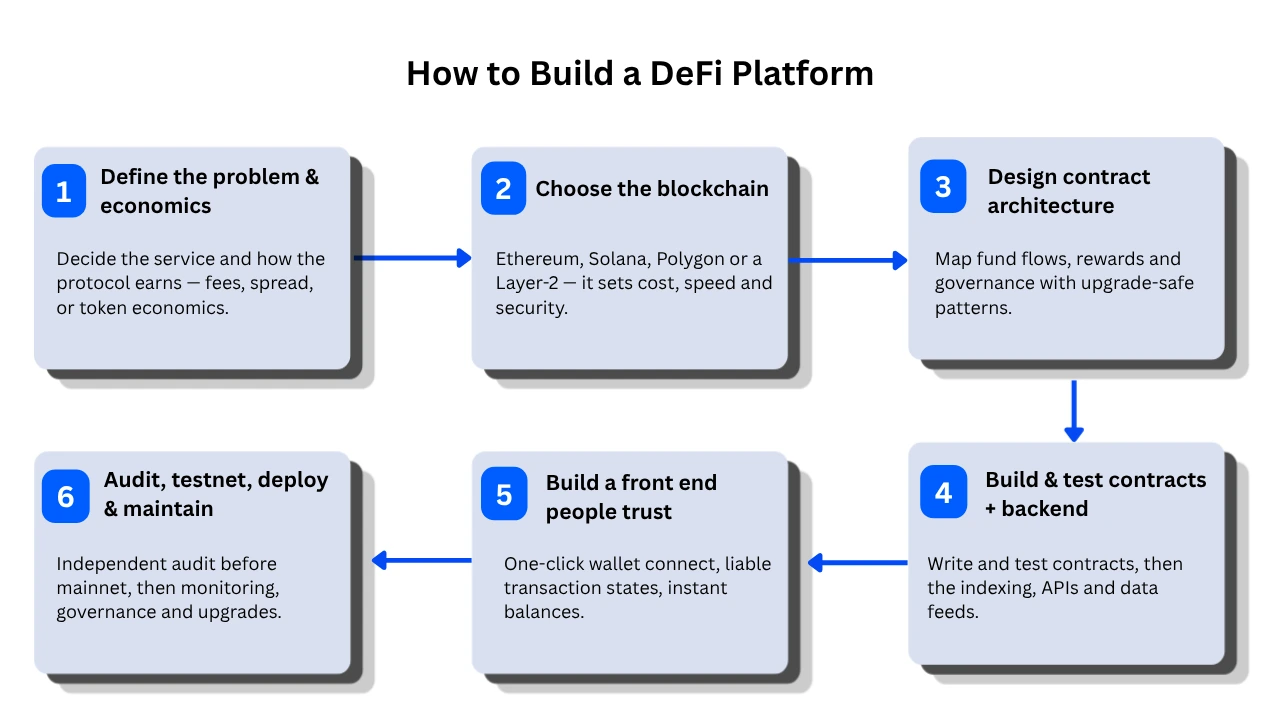
A DeFi platform is not built overnight, and skipping stages is exactly how projects lose user funds later. A dependable process looks like this:
1. Define The Problem and Business Model
Decide what financial service you are offering and how the protocol earns — transaction fees, a spread, staking fees, or token economics. Research competitors and map the user you are serving before a line of code is written.
2. Choose The Blockchain
This is the foundation, and it dictates cost, speed, and security. Ethereum offers the deepest liquidity and tooling; Solana and Polygon offer faster, cheaper transactions; Layer-2 networks like Arbitrum balance Ethereum’s security with lower fees. Your choice depends on your users and budget. Teams often pair this decision with Ethereum or Solana blockchain development expertise depending on the target chain.
3. Design the Smart Contract Architecture
Model the economic logic — how funds move, how rewards are calculated, how governance works — and decide what runs on-chain versus off-chain. Enterprise builds use modular, upgrade-safe contracts so the protocol can evolve without disrupting deposited capital.
4. Build the Contracts and Backend
Write and repeatedly test the smart contracts, then stand up the off-chain infrastructure — indexing, data feeds, and APIs — that keeps the front end responsive. Reliable dApp development depends on this unseen layer as much as the contracts themselves.
5. Develop the Frontend
Users judge trust at the interface. A clean, fast UI with wallet connection, clear transaction states, and readable data is not cosmetic — it directly affects adoption.
6. Audit, Test, and Deploy
Run the contracts through internal testing, a public testnet, and at least one independent security audit before mainnet. Post-launch, plan for monitoring, governance, and ongoing maintenance, because a DeFi protocol is a living system, not a shipped product.
The DeFi Development Tech Stack
Peel back a working platform and the toolkit is fairly consistent.
The Contract Layer
You write in Solidity for Ethereum and EVM chains, or Rust for Solana. Hardhat and Foundry handle compiling, testing, and deploying. Because a contract is blind to anything off-chain, you connect an oracle — Chainlink is the standard — to feed in real-world data like prices, without which a lending protocol could not know when to liquidate.
The Application Layer
The front end is usually React or Next.js with Web3 libraries like Wagmi, ethers.js, or Web3Modal, which connect the browser to a user’s wallet. An indexer such as The Graph makes on-chain data load quickly. Wallet integration ties it together — where crypto wallet development meets the protocol. One trend worth building in is account abstraction (EIP-4337), enabling gasless transactions and one-tap onboarding. If you are weighing options, a short round of blockchain consulting usually pays for itself.
What DeFi Development Really Costs
Cost varies enormously because “a DeFi app” can mean one staking contract or a full exchange. As a realistic 2026 range, a basic single-feature app starts around $40,000, while a complex lending protocol or exchange can run $500,000 or more. Chain choice moves it too: Ethereum builds typically land between $100,000 and $250,000, Solana between $70,000 and $150,000, and Polygon between $75,000 and $160,000.
Four things drive the number. Protocol complexity comes first — every feature widens the testing and audit surface. Security and auditing come second and often eat close to half the budget, because a deployed contract holds real money and cannot be quietly patched. Third is the blockchain and its tooling; fourth is compliance, which grows sharply under KYC and AML obligations.
The smart way to control spend is a focused MVP on a low-fee Layer-2, proven with real users, then expanded. The shortcut that reliably backfires is trimming the audit. For a scoped estimate, it is worth a conversation with a DeFi development company before you commit to a budget.
DeFi Security: Where the Money Gets Lost
Security is not a milestone in decentralized finance development; it is the discipline wrapped around the code. Because contracts are immutable once live, a single overlooked line can drain a protocol. The scale is not hypothetical: DeFi suffered 121 hacks in 2026 for about $942 million in losses, with two April attacks accounting for more than half.
How DeFi Exploits Actually Happen
A reentrancy attack tricks a contract into repeating a withdrawal before it updates its balance — the flaw behind the DAO hack. Oracle manipulation feeds a contract a fake price so an attacker borrows far more than their collateral is worth. Flash loan attacks borrow a huge sum with no collateral, distort a market in a single transaction, and repay before the block closes. Add liquidity risk and regulatory risk, and you have the threat map every serious build must answer.
How to Defend a DeFi Protocol
A credible response is layered: multiple independent audits, formal verification for the contracts that hold funds, conservative oracle design pulling from several sources, real-time monitoring after launch, and a bug bounty. The rule of thumb is blunt — if your protocol holds user funds, security belongs at the top of the budget.
DeFi Rules in India
If you are building or investing from India, the regulatory picture is specific enough to know before you write a line of code. DeFi is not banned, but it operates without dedicated regulation. Profits from virtual digital assets (VDAs) face a flat 30% rate plus 4% cess and a 1% TDS on transfers under Section 194S, and losses cannot be set off against other gains. From 1 April 2026, the Finance Act 2025 folded “crypto-asset” explicitly into the VDA definition and tightened platform reporting.
DeFi makes this messier than plain trading. Staking rewards, yield farming income, and liquidity provision are taxable at receipt and again on transfer, and even a crypto-to-crypto swap is a taxable event. Swap ETH bought for ₹1,50,000 into a token worth ₹2,00,000 and you owe 30% on the ₹50,000 gain, though no rupees hit your bank. India’s exchanges also fall under PMLA rules and must register with FIU-IND, which is why compliant platforms ask for PAN and Aadhaar. Globally the direction is alignment with FATF standards and the OECD’s reporting framework, so designing compliance in early beats bolting it on later.
Turn Your DeFi Idea into a Powerful Blockchain Solution
Build innovative decentralized finance platforms with secure architecture, seamless performance, and expert blockchain development services.
Request a Consultation
How Comfygen Builds DeFi Products
At Comfygen, we treat a DeFi build as financial infrastructure, not a standard app, because it carries real capital from day one. Our work runs the full lifecycle — economic design, smart contract engineering, front-end integration, independent auditing, and post-launch support — across Ethereum, Solana, Polygon, and Layer-2 networks. Whether you want a decentralized exchange, a lending protocol, a staking platform, an NFT marketplace tied into DeFi, or tokenized real-world assets, we start with architecture and security and let features follow.
The practical first move is a scoped conversation about what the protocol should do and who it serves. You can reach out to our team, or hire dedicated blockchain developers to strengthen an in-house team. Decentralized finance is a genuine rebuilding of financial services on open rails, and the products that last are built with discipline — sound economics, audited code, and respect for what can go wrong.
Conclusion
The arrival of decentralized finance development services serves as a revolutionary milestone in the domain of financial services. Accessibility of financial services can be influenced by utilizing blockchain technology to create DeFi development solutions. Interestingly, DeFi app solutions are not limited to offering only one type of financial service.
You can explore different types of traditional financial services in a completely new way with the DeFi platform. The value advantages of decentralization application development services, immutability, interoperability, cryptographic security, and innovation would help in empowering the adoption of DeFi development services in the future. On top of it, the growing interest in web3 is also a major aspect that would play in favor of the adoption of DeFi platform.
FAQs
How much does DeFi development cost in 2026?
Which blockchain should I choose for a DeFi platform?
Is DeFi legal to use and build in India?
How long does it take to build a DeFi app?
What causes most DeFi hacks?

Mr. Saddam Husen, (CTO)
Mr. Saddam Husen, CTO at Comfygen, is a renowned Blockchain expert and IT consultant with extensive experience in blockchain development, crypto wallets, DeFi, ICOs, and smart contracts. Passionate about digital transformation, he helps businesses harness blockchain technology’s potential, driving innovation and enhancing IT infrastructure for global success.